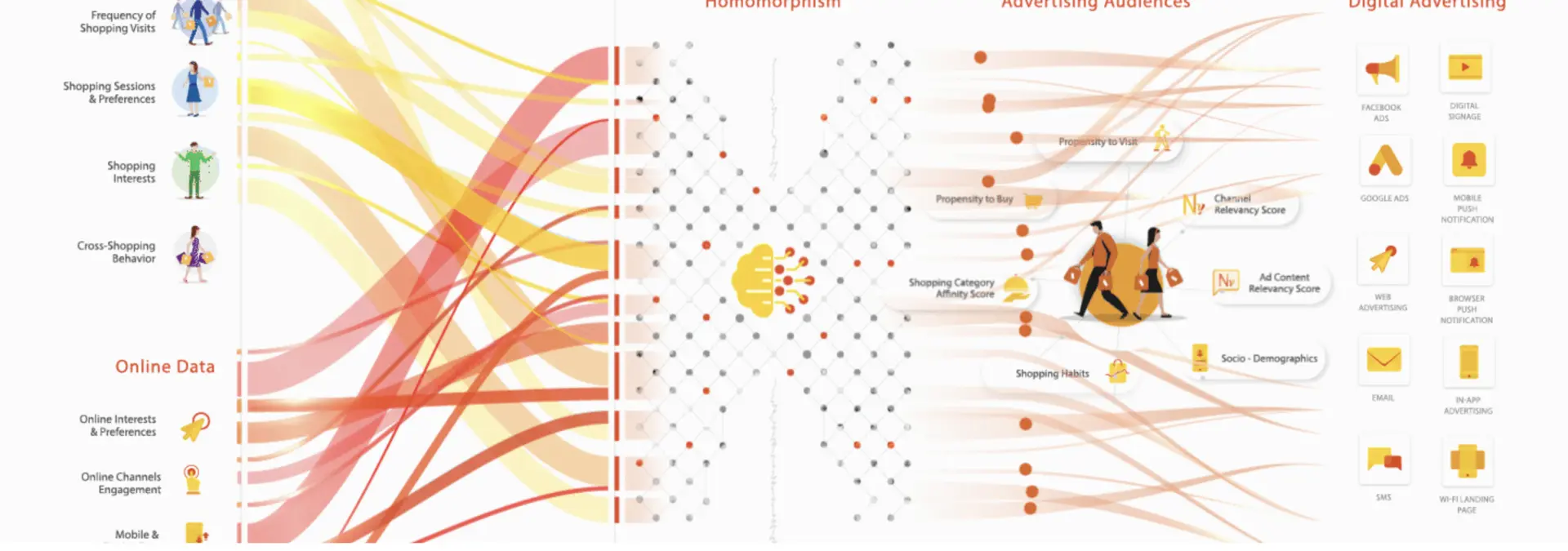
Homomorphism: How Footprints AI Differentiates
The Concept of Homomorphism
Inspired by the Greek term homoios morphe (i.e., similar form), the concept of homomorphism is used to describe how corresponding elements of two systems behave very similarly when combined with other corresponding elements. In the context of retail, this principle is applied to the relationship between offline and online shopping behaviors.

Footprints for Retail's Homomorphism Framework
"Homomorphism" represents Footprints for Retail's advanced AI framework that empowers their unique technology to enrich any online database, at the individual user level, with their physical/offline shopping behavioral characteristics. Physical/offline behavioral data and affinity clustering is the most valuable type of data for Online Behavioral Advertising and Marketing Automation. Footprints for Retail classifies subtle physical shopping behaviors into multidimensional clusters (up to 48 different behavioral data dimensions) and then matches these clusters with their online "twins." This probabilistic attribution model generates unprecedented benefits for marketers and advertisers working with physical retail brands and objectives. It allows campaigns to be targeted towards very specific behavioral segments in order to increase the Frequency of Visits, the Visit Duration, and the number of Shops per Visit inside a certain Shopping Center.
Retail Analytics: The Foundation of Homomorphism
The Retail Analytics section within the Footprints for Retail platform is responsible for collecting the offline behaviors that are essential for the homomorphism framework. Built on cutting-edge modern technologies and with a highly scalable architecture, Footprints Retail Analytics transforms raw location data into accurate and meaningful insights.
Architectural Approach and Technical Details
The Footprints Retail Analytics architecture follows a decentralized model, with a central hub that distributes the data and independent nodes, one for each building (location). This approach ensures infinite scalability, with one VM (Virtual Machine) or Docker container per location, or any number of VMs for a single, large location.
The technology stack includes a Linux-based (Ubuntu) operating system, Node.js programming language, MongoDB NoSQL database for data storage, and Redis in-memory database for rapid data processing.
Data Privacy and Compliance
The data collected within the Footprints for Retail platform is processed in three different ways, depending on the desired configuration of the system:
- Total MAC anonymization, where each collected MAC address is fully scrambled when a visit into the building is finalized, and the real MAC address is never saved into the database.
- Partial MAC anonymization, where the MAC address is pseudonymized and then partially scrambled, allowing the ability to track the same scrambled MAC address across visits while ensuring a high level of privacy.
- No MAC anonymization, which leverages the full reporting power of the system, including various reports concerning the recurrence and recency of unique or returning visitors.
The system also offers a configurable data deletion policy, such as automatically deleting data after a period of one year, to ensure compliance with privacy regulations like the General Data Protection Regulation (GDPR).
Ready to see how this works in practice?
Footprints AI helps brands and retailers measure what matters. See our customer success stories or get in touch to discuss your retail media strategy.